Zone 2 Running
If you want to run faster, go farther, and bounce back quicker, the secret might be doing something that feels counterintuitive: slowing down.
While high-intensity workouts often steal the spotlight, Zone 2 running has quietly become the gold standard for long-term athletic success and metabolic health. Popularized by endurance coaches and longevity experts like Dr. Peter Attia, low-intensity aerobic training is now recognized as one of the single most effective ways to build a powerful physical foundation.
Here is a breakdown of what Zone 2 running actually is, why it works, and how to integrate it into your training.
What Is Zone 2 Running?
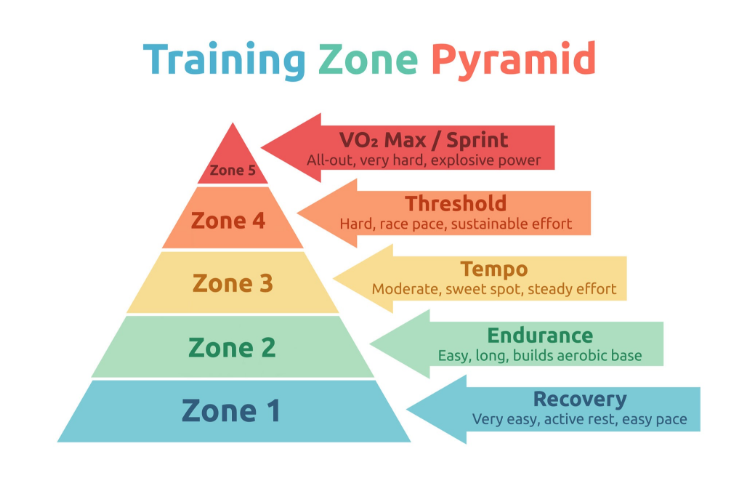
Heart rate-based training divides your cardiovascular effort into five distinct zones, ranging from very light effort (Zone 1) to maximum effort (Zone 5).
Zone 2 sits at roughly 60% to 70% of your maximum heart rate. It represents a comfortable, sustained pace where your cardiovascular system works at peak efficiency without accumulating excessive fatigue.
On a standard training plan, Zone 2 corresponds to your easy runs and the vast majority of your weekly long runs. It serves as the bedrock for every distance from a local 5K to a full marathon.
The Science: Why Zone 2 Works
Running at an easy pace does far more than just burn calories—it triggers crucial physiological adaptations that high-intensity runs simply can't replicate on their own:
- Builds your "aerobic engine" (more mitochondria): Zone 2 training stimulates your cells to grow more—and larger—mitochondria (the powerhouses of your cells that convert food into ATP energy). More mitochondria mean a bigger energy supply for your muscles during long efforts.
- Keeps blood lactate stable: Blood lactate is a byproduct of muscle metabolism. In Zone 2, your body clears lactate as quickly as it produces it. Staying below your lactate threshold prevents the burning sensation and rapid fatigue caused by high-intensity efforts.
- Teaches your body to burn fat for fuel: At lower heart rates, your body relies primarily on fat oxidation rather than limited glycogen (carbohydrate) stores, making you a much more efficient endurance engine over long distances.
- Accelerates recovery and consistency: Because Zone 2 puts lower mechanical and nervous-system stress on your body, your recovery time is significantly shorter. This allows you to log more weekly mileage without increasing your risk of injury or burnout.
How Zone 2 boosts speed: By expanding your mitochondrial base during easy runs, you supercharge high-intensity workouts (Zones 4 & 5). High-intensity sessions make those mitochondria work more efficiently—giving you maximum power when you hit race pace.
How to Find Your Zone 2 Pace
You don't necessarily need high-tech gear to pinpoint your Zone 2 effort. Here are three reliable methods to gauge your intensity:
| Method | How to Measure | Best For |
|---|---|---|
| Heart Rate Monitor | Aim for 60%–70% of your max heart rate. (To estimate max HR accurately, track your peak rate during an all-out effort rather than using generic formulas). | Tech-focused runners with a chest strap or GPS watch |
| The Talk Test | You should be able to speak in full, fluent sentences without gasping for breath between words. | Daily running without gadgets |
| Perceived Exertion (RPE) | On a 0–10 Rate of Perceived Exertion scale (where 0 is resting and 10 is max sprint), target a 4 out of 10. | Beginners building body awareness |
How to Structure Zone 2 in Your Training
The classic rule of thumb used by world-class distance runners is the 80/20 Rule:
- 80% of your total weekly mileage should be spent in Zone 2 (easy runs, recovery runs, long runs).
- 20% of your mileage should be reserved for higher-intensity work in Zones 3 to 5 (tempo runs, hill repeats, track intervals).
- Note: If you are brand new to running, increasing Zone 2 volume to 90% of your weekly routine helps safely build tendon, joint, and aerobic durability before adding heavy speedwork.
How long should a Zone 2 run be?
- 5K / 10K Training: 25 to 35 minutes per easy session.
- Half Marathon / Marathon Training: 40 to 90+ minutes depending on your training block.
When Will You See Results?
Consistency is key. Most runners begin noticing subtle structural gains—like lower heart rates at their usual easy pace or feeling less winded on daily routes—within 2 to 4 weeks.
However, aerobic development is a long game. Unlike fast fitness gains from hard interval training that plateau quickly, your aerobic capacity can continue expanding for years if you consistently feed it steady Zone 2 volume.